KAIST HUBO (KHR-3)
HUBO, built by Oh Jun-Ho's lab at KAIST in 2004, was South Korea's first walking humanoid. The Albert HUBO version paired it with a Hanson Robotics Einstein head.
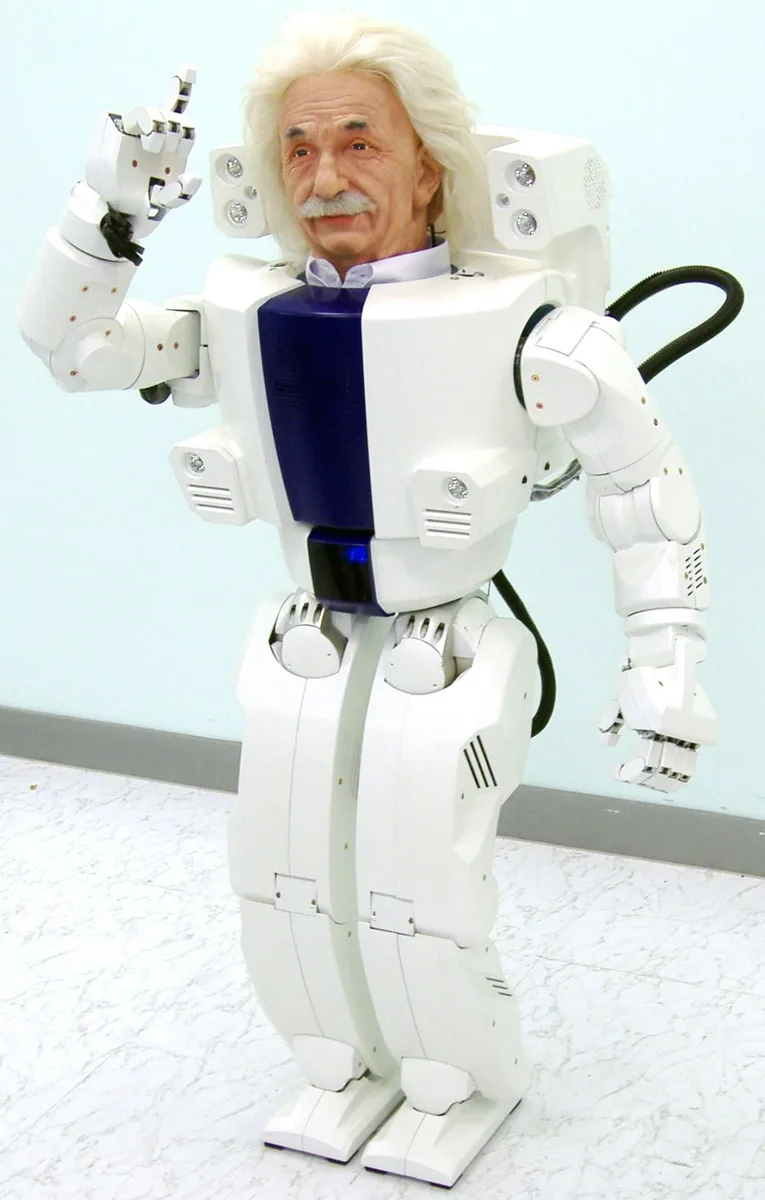 Dayofid at English Wikipedia via Wikimedia Commons · CC BY 2.5
We have not sat down with this one. The score below is computed from the data we hold, and the facts on this page are sourced. It is not on sale, so there is nothing to recommend.
How the score is built
Capability is what the machine physically does. Value compares it with others at a similar price, not with the whole market. Buyability asks whether you can really order one. Ecosystem is the software and community around it. Proof is what it has done in the field, which is where most humanoids score badly and should.
- Status
- Retired
- Category
- historic
- First revealed
- January 2005
- Form
- bipedal
- Height
- 125 cm
- Weight
- 55 kg
- Payload
- n/a
- Degrees of freedom
- 41
- Battery
- n/a
- Runtime
- n/a
- Walking speed
- 0.35 m/s
- Actuation
- electric DC motors with harmonic drives
- Units deployed (est.)
- not disclosed
- Teleoperation
- partial
Where it stands
Korea's first full-size walking humanoid, completed at KAIST in late 2004; Albert HUBO variant with an Einstein head shown 2005.
What stands out
- Korea's first walking humanoid
- Albert HUBO at APEC 2005
Autonomy, observed
Walking, dancing and handshake demos; Albert HUBO greeted APEC leaders in Busan in November 2005.
Hands, sensors, brain
- Hands: five-finger hands
- Sensors: cameras, force torque sensors, IMU
Price and volume
Research robot.
Milestones.
KAIST completes HUBO (KHR-3)
Jun Ho Oh's team at KAIST completes HUBO, a 125 cm, 55 kg humanoid and the first Korean full body humanoid. The HUBO line later wins the DARPA Robotics Challenge finals in 2015.
Other robots by KAIST.
Sources
- 01HUBO, WikipediaWikipedia
Spotted a wrong price or a broken fact? Send a correction. Fixed within 24 hours when sourced.