The uncanny valley, and why the newest humanoids have no face
Masahiro Mori warned in 1970 that a nearly human face repels. Of the 182 humanoids in our record, four describe one, and none of the four does physical work for a customer.
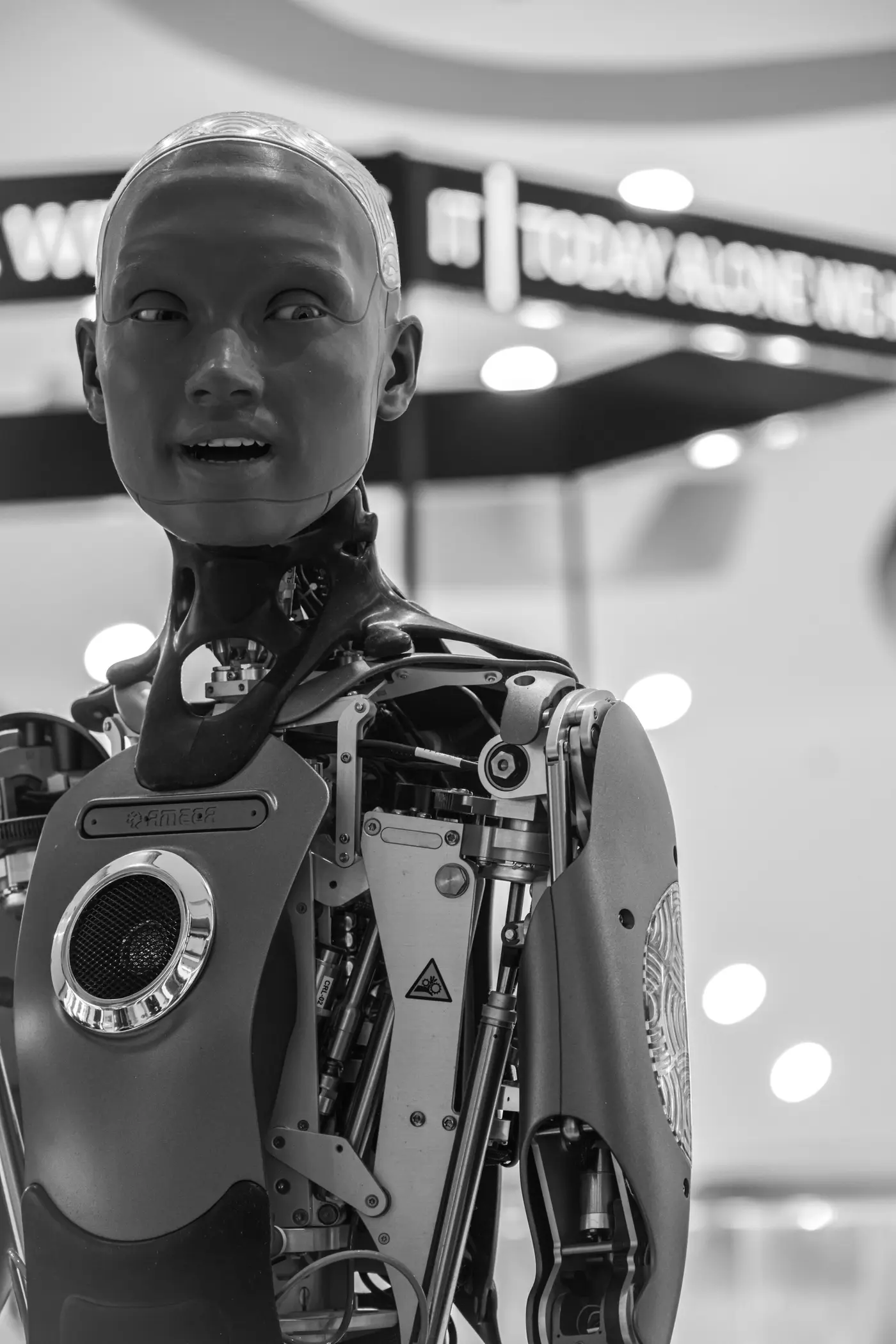
We keep records on 182 humanoid robots. Search them for a machine with a face of its own, skin and expressions included, and you find four. Two are torsos, one is an option, one a prototype. Of the 72 records in the categories where someone pays for a task, one mentions a face, and it is the option, on a machine you cannot order yet. That is a decision, and the records show why.
What the uncanny valley actually says
Masahiro Mori, a Japanese roboticist, published a short essay in 1970. His claim: as a machine looks more human, people warm to it, until it gets very close and the reaction flips to unease. A hand with skin that is slightly wrong is worse than a hand that is clearly a tool. That dip is the valley. Mori meant it as a warning. For decades the robots that made the news stood in it.
The four machines with a face
Sophia, from Hanson Robotics, was activated in February 2016 and given Saudi citizenship on 25 October 2017. It is an upper-body machine with cameras in the eyes and chest; the legs added in 2018 were a research add-on. Its dialogue can be scripted or operator assisted.
Ameca, from Engineered Arts, was unveiled in December 2021 and is known for realistic facial expressions and LLM-driven conversation. Also upper-body, legs still experimental. It is sold and rented to museums, labs and events; its Dubai museum deployment is logged as mixed autonomy.
Noetix Hobbs is a 2025 research platform with an expressive bionic face, a prototype that is not for sale.
Unitree H2, revealed in October 2025, is a full-size 180 cm walker on which Unitree offers a human-like face as an option called Bionic Companion. The price is listed at $29,900, there is no buy button, and the autonomy evidence is dance and catwalk demos.
Hanson’s Grace, derived from Sophia, is not counted: its record does not describe the head. The pattern holds: faces belong to machines whose product is the interaction itself. Skin is the same. Two records mention it: Fourier GR-3, sold by Fourier for elder care at a reported $100,000 with 31 pressure sensors in a soft skin, and iCub, a research platform with tactile skin. Skin goes where touch is the job.
What the working machines wear instead
| Machine | What the record says about the head | Sold as |
|---|---|---|
| Sophia | Expressive face, cameras in eyes and chest | Media and conference presence |
| Ameca | Realistic facial expressions, cameras in eyes | Rented and sold to museums and events |
| Unitree H2 | Human-like face as an option | Entertainment platform, $29,900 listed, no order path |
| Digit | Head with LED eyes, depth cameras, lidar | Tote handling for GXO since June 2024 |
| Figure 03 | Head cameras, soft textile coverings | Home alpha and pilots, not for sale |
| NEO | Soft suit, no face listed | Home robot, $20,000 or $499 a month |
| Optimus Gen 2 | Actuated neck, cameras | Tesla factory trials, not for sale |
| Unitree G1 | Depth camera and 3D lidar, no face listed | Research platform, $13,500 |
Five categories cover machines someone pays to do a task: general-purpose, industrial, home, logistics, service. They hold 72 of the 182 records. One mentions a face, the H2 option. The other 71 do not.
Digit is the clearest case. Agility Robotics gave the 2023 version a head with LED eyes, two-finger end effectors instead of hands, and a multi-year GXO contract moving totes. The record notes remote monitoring, so its teleoperation is partial.
Figure 03 lists head cameras, palm cameras and fingertip sensors sensitive to about 3 grams. Figure AI says Helix runs onboard with no teleoperation, and that training data is collected by teleoperation. Its predecessor Figure 02 loaded sheet metal at BMW Spartanburg for about 11 months without a face.
NEO from 1X wears a soft suit over a 30 kg body and ships with a disclosed Expert Mode in which a remote human takes over; reviewers at launch found most tasks teleoperated. Tesla staff confirmed that Optimus Gen 2 units at the We Robot event on 10 October 2024 were remotely assisted.
Why the face came off
Trust. A worker beside Digit needs to know where it is going, not whether it likes them. LED eyes give the first and refuse the second.
Cost. The two face robots sold as products are torsos. The walkers put their engineering into legs, hands and batteries. No record shows a shipping product with both.
Expectation. A face promises a mind. Sophia’s record says operator assisted dialogue, Ameca’s says mixed autonomy, Optimus was remotely assisted at Tesla’s own event. A face on a teleoperated machine is a claim it cannot back. A visor makes no claim.
None of this is new. In 2005 KAIST put a Hanson Robotics Einstein head on its HUBO walker to greet APEC leaders as Albert HUBO. UBTech’s 2018 Walker had legs, a torso screen and no arms. Clone Robotics’ Protoclone is a faceless android. The face has gone on and off for twenty years. It only looks settled now because the machines finally do something.
How to read a robot with no face
A faceless machine is not honest by default. A knit suit hides as much as silicone does. Before you trust one, check four things. What sensors the head carries, by name. Whether teleoperation says no, partial or yes, and whether the maker said so before a reporter did. Whether it is sold for a named task to a named customer, or as a general-purpose and entertainment platform. And whether the price has a buy button behind it. The machines that took the face off and still hide the operator deserve the harder look.
Sophia
Sophia is the expressive-face humanoid from Hong Kong's Hanson Robotics, activated in February 2016. It became the first robot granted citizenship (Saudi Arabia, October 2017) and is mainly a media and conference presence.
Ameca
Ameca is Engineered Arts' expressive humanoid, unveiled in December 2021 and shown at CES 2022, best known for realistic facial expressions and LLM-driven conversation. Gen 2 arrived in 2023 with a modular design. It is used for research, exhibitions and events rather than physical work.
Unitree H2
H2 is Unitree's third full-size humanoid, revealed in October 2025 with 31 degrees of freedom, 180 cm height and 70 kg weight. It is positioned as a general-purpose and entertainment platform.
Noetix Hobbs
Hobbs is a Noetix humanoid with an expressive bionic face, shown as a research and interaction platform in 2025.
Grace
Grace is a nurse-styled companion humanoid derived from Sophia, developed by Hanson Robotics and SingularityNET for elder care and hospitals.
Fourier GR-3
GR-3 is Fourier's care-oriented humanoid with a soft, sensor-covered exterior and a rounded design meant for elder care and rehabilitation. It marks Fourier's move from research platforms to healthcare products.
iCub
iCub is the open-source child-sized humanoid developed by the Istituto Italiano di Tecnologia in Genoa from the EU RobotCub project (2004 to 2010). With 53 DoF and full-body tactile skin, it became a standard platform for cognitive robotics research, with dozens of units in labs worldwide. iCub3, a larger 125 cm version, was introduced in 2021.
Digit
The 2023 Digit added a head, improved hands and a taller frame, and is the version Agility Robotics sells as a service for moving totes in warehouses. It was the first humanoid with a paid, multi-year commercial deployment (GXO, 2024) and is built at Agility's RoboFab factory. Schaeffler invested in Agility in 2024 and planned to deploy Digit in its plants.
Figure 03
Figure 03 is Figure AI's third-generation humanoid, unveiled on 9 October 2025 and designed for the home and for volume manufacturing at Figure's BotQ facility. It has soft textile coverings, wireless charging, palm cameras and tactile fingertips, and runs the Helix model onboard. It is the company's first robot designed for mass production rather than hand assembly.
Figure 02
Figure 02, unveiled on 6 August 2024, added onboard speech, six cameras, 16 DoF hands and three times the compute of Figure 01. It became the first Figure robot to work in a customer plant, at BMW Spartanburg, and the platform for the Helix vision-language-action model. Figure retired it in favour of Figure 03 in late 2025.
NEO
NEO is 1X's consumer home humanoid, opened for preorder on 28 October 2025 at USD 20,000 with deliveries planned for 2026. It is about 30 kg, tendon-driven and wears a soft suit, and it uses remote human operators for tasks it cannot yet do autonomously. It is the first humanoid marketed directly to households at a published price.
Optimus Gen 2
Optimus Gen 2, revealed on 12 December 2023, is about 10 kg lighter than Gen 1, walks 30 percent faster and has Tesla-designed actuators, an actuated neck and tactile fingers. It has been used for internal factory trials and at Tesla marketing events, where it was partly teleoperated. It is the version the public has seen most.
Unitree G1
G1 is Unitree's compact humanoid, announced in May 2024 at USD 16,000 and now listed at USD 13,500. Its low price and open SDK made it the default research and education humanoid worldwide. Read the configuration carefully: the standard machine does not support your own code, and the EDU version that does starts at USD 43,900.
KAIST HUBO (KHR-3)
HUBO, built by Oh Jun-Ho's lab at KAIST in 2004, was South Korea's first walking humanoid. The Albert HUBO version paired it with a Hanson Robotics Einstein head.
UBTech Walker (2018 and 2019)
Walker was UBTech's first full-size humanoid. The CES 2018 version had legs and a torso screen but no arms; the CES 2019 version added arms and hands with 36 degrees of freedom.
Protoclone
Protoclone is Clone Robotics' faceless musculoskeletal android with over 1,000 artificial muscle fibres, a synthetic skeleton and around 500 sensors. A video in February 2025 showed it twitching while suspended. It is the technology demonstrator for the planned Clone Alpha.
Sources
- 01Sophia (robot)Wikipedia
- 02SophiaHanson Robotics
- 03AmecaEngineered Arts
- 04Unitree H2Unitree
- 05Noetix RoboticsNoetix Robotics
- 06Agility RoboticsAgility Robotics
- 07Introducing Figure 03Figure AI
- 08NEO1X Technologies
- 09Optimus (robot)Wikipedia
- 10Fourier GR-3Fourier
How a humanoid robot works: actuators, compute, sensors and the model
Of 182 humanoids on record, 178 say what moves the joints and 43 say what computer is inside. The further a layer sits from the metal, the less the maker tells you about it.
Startups, automakers, universities: who builds humanoids
108 makers, nine kinds. Startups hold 37 of the 44 humanoids you can order. Automakers, universities, big tech, conglomerates and NASA hold 45 robots between them and sell none of them.
What humanoid robots can actually do in 2026
Of 182 humanoid robots on record, 117 have a human in the loop, 33 have ever worked at a customer site and none has a verified fleet count. Here is what that leaves.