How a humanoid robot works: actuators, compute, sensors and the model
Of 182 humanoids on record, 178 say what moves the joints and 43 say what computer is inside. The further a layer sits from the metal, the less the maker tells you about it.
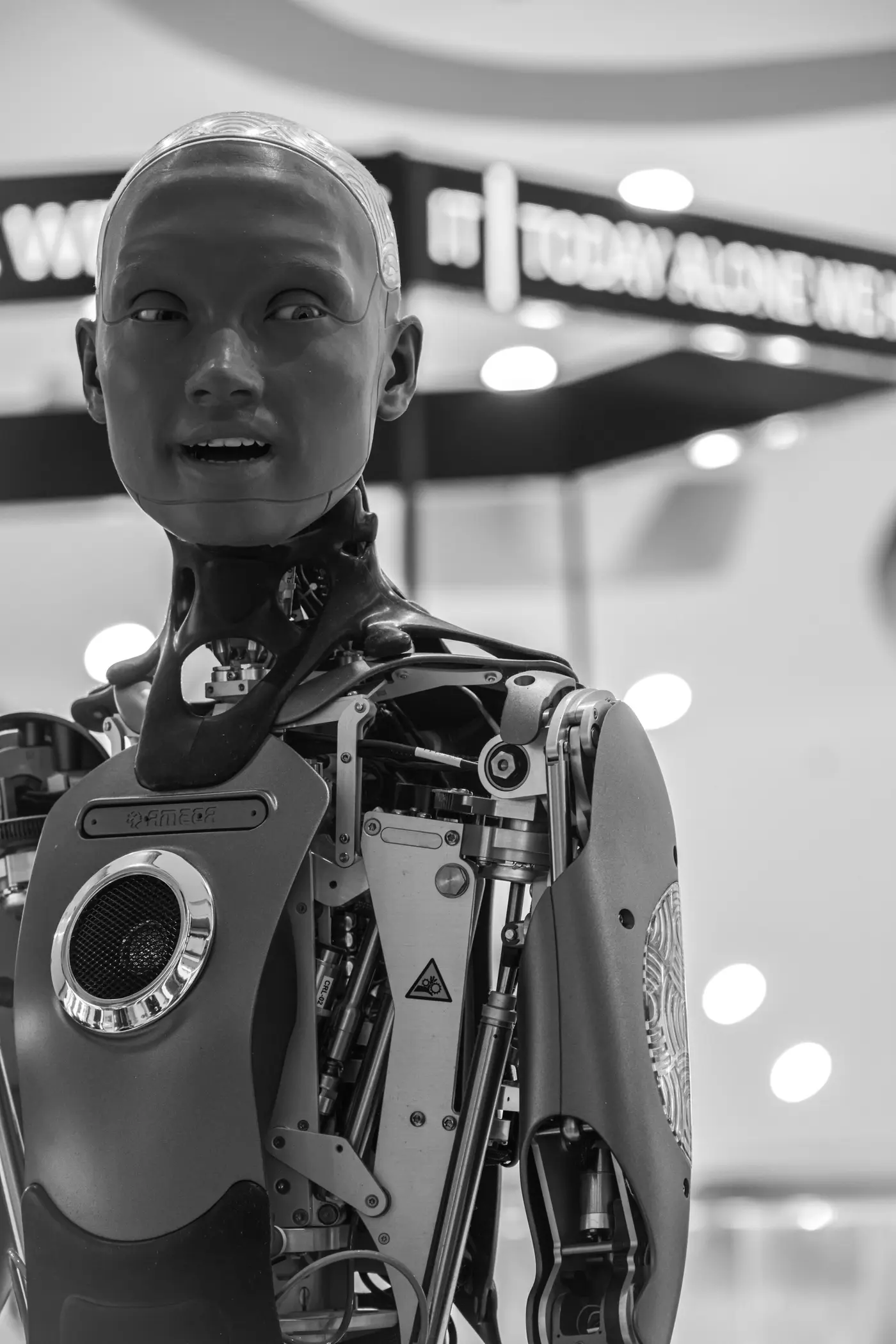
A humanoid is four layers. Actuators move the joints. Sensors see and feel. A computer runs the maths. A model decides what to do next. Our 182 records describe the first layer 178 times and the third layer 43 times. Makers are precise about motors and vague about brains, and the vagueness sits exactly where a human operator can hide.
The four layers and how often anyone describes them
Field coverage across the 182 records, with the most common answer.
| Layer | Field | Records filled | Most common answer |
|---|---|---|---|
| Actuators | actuation |
178 of 182 | “electric” with nothing else (87) |
| Joints | dof |
83 | 28 joints (6 machines); median 32 |
| Compute | compute |
43 | a generic “onboard computer” (7); Nvidia Jetson (6) |
| Sensors | sensors |
64 | a camera (47); an IMU (23) |
| Model | ai_stack |
78 | reinforcement-learning locomotion (17) |
| Human in the loop | teleoperation |
148 (34 unknown) | partial (90) |
Only 18 of the 182 fill all five technical fields, and 56 fill none of the four beyond actuation. Of the 44 machines you can order, 25 publish a joint count, 9 name the computer and 10 list the sensors. You are asked to buy a body whose spec sheet stops at the motors.
Actuators: electric has won and hydraulics are in the museum
The actuator is the motor plus gearing at each joint. It sets what the robot can lift, how fast it moves and what wears out first. Of the 178 records that describe it, 170 are electric only, 7 mention hydraulics and 1 (NAVER AMBIDEX) is cable-driven.
The hydraulic seven are mostly history. The hydraulic Atlas from Boston Dynamics had 28 hydraulic joints and was retired on 16 April 2024 after 11 years, replaced by the electric Atlas. Its predecessor PETMAN was hydraulic and tethered. WABOT-1 from 1973 had hydraulic legs. Nadia at IHMC has some hydraulic joints. Phoenix from Sanctuary AI puts miniature hydraulic hands on an electric body. The last two are Clone Robotics’ Protoclone and Clone Alpha, artificial muscles driven by a water pump; the Alpha has no delivered unit and no public price.
Electric wins because it runs on a battery, does not leak and is cheap in volume. The word on its own tells you nothing: 87 records say it and stop. Only 5 give a torque figure: the Unitree G1 at up to 120 Nm in the knee, the Unitree H1 at up to 360 Nm, Fourier GR-1 and Xiaomi CyberOne at 300 Nm, AgiBot Raise A1 at 350 Nm. Five name linear actuators, among them Optimus Gen 1 and Apollo from Apptronik. Four are tendon-driven: the three NEO generations from 1X and Roboy. Six say in-house or custom. The torque number is the one that predicts payload, and 173 records do not give it.
Joints: 83 publish a count and the famous machines do not
Degrees of freedom is the number of independently moving joints. 83 records give a figure. The minimum is 12 (Berkeley Humanoid), the median is 32, the mean is 35.7. The maximum is 200 for Protoclone, a musculoskeletal android with over 1,000 artificial muscles and not comparable; leave it out and the top is Xpeng Iron at 82, then HopeJR at 66, an open-source kit on preorder at a $3,000 target price. 11 machines are under 20 joints, 24 are in the twenties, 18 in the thirties, 18 in the forties and 12 at 50 or more.
The count is silent on where the joints go: Iron puts 22 of its 82 in each hand. We covered that in why hands are the hardest part. The count is also silent on the best-known machines. Figure 02, Figure 03, Optimus Gen 2, the electric Atlas, NEO, Digit and Apollo have no total joint count in our record. Among the 44 you can order, 25 publish one, with a median of 24. A high count is a bill of materials, not a capability: HopeJR publishes more joints than the electric Atlas record shows, and it is a hobby kit.
Compute: 43 name a computer, 6 say Jetson, none say Thor
The computer runs the balance loop and, on newer machines, the network that turns camera frames into joint targets. 43 records name it. Nvidia Jetson appears 6 times: the G1 EDU, the H1 as an option, the Unitree R1 EDU, Booster T1, EngineAI PM01 and Hexagon AEON. Four of those specify the Orin generation. Jetson Thor, which Nvidia’s own record says went on general sale in August 2025 at $3,499 for the developer kit, appears in no robot record at all.
Three run in-house silicon: Optimus Gen 1 and Gen 2 on a computer derived from Tesla’s FSD chip, and Iron on three Xpeng Turing chips at about 2,250 TOPS. Only Iron and the G1 give a TOPS figure. Five name an Intel x86 part, from an Atom in DARwIn-OP to a Core i7 in the H1. Two use a Raspberry Pi, two an Arduino, two a cloud brain (EMIEW3 and AMBIDEX over 5G). Seven say only that there is an onboard computer. Figure 03’s record says Helix runs onboard and details are not published.
The compute line decides who can run their own code. A Jetson with an open SDK is a computer you can log into; the G1 base ships an 8-core CPU and the 100-TOPS Orin NX is EDU only, the ladder in the G1 article. An in-house chip is a computer the maker programs and you do not. 35 of the 44 buyable machines do not name theirs, so ask.
Sensors: cameras on 47, touch on 8
Sensors are what the model gets to know. A camera gives pictures, a depth camera distance, lidar a 3D map for walking, an IMU the sense of falling, tactile sensors a feeling of grip. 64 records list sensors. 47 mention a camera, 23 an IMU, 17 a depth or stereo camera, 12 lidar, 15 microphones. 19 mention touch, force or pressure sensing, and 8 use the word tactile: Figure 03 with fingertip tactile sensors and palm cameras, Optimus Gen 2 with tactile fingertips and foot force sensors, Fourier GR-3 with 31 pressure sensors in a soft skin. Five list cameras and nothing else.
The mix tells you what the maker thinks the model needs. The G1 ships a RealSense depth camera, a Livox lidar and a microphone array, the kit of a robot expected to map a room. Figure 02 lists six RGB cameras, microphones and speakers, and no depth camera or lidar: the bet that a vision-language-action model can work out distance from pixels. Digit carries depth cameras and lidar for warehouse aisles. Of the 44 you can order, 10 list any sensor at all.
The model: 78 name software, 19 name a model, GR00T is on none
The model turns sensor data into joint commands. 78 records say something here. 17 say reinforcement-learning locomotion, meaning the walking was trained in simulation. 13 point to open software. 7 say VLA. 19 name a specific behaviour model: Helix on Figure 02 and 03, GO-1 on AgiBot A2 and Genie G1, Google DeepMind’s Gemini Robotics on Apollo and the electric Atlas, GraspVLA on Galbot G1, Redwood on NEO, Xpeng’s VLA on Iron, ERA-42 on Robotera L7, Carbon on Phoenix, Tesla’s end-to-end networks on Optimus, Huawei Pangu on Leju Kuavo, Huisi Kaiwu on Tiangong 2.0, Ant Group’s model on Robbyant R1, an in-house VLA on Menteebot and Stanford’s shadowing transformer on HumanPlus. Nvidia’s GR00T N1, released 18 March 2025 as an open humanoid foundation model and shown on NEO that day, is the named stack of no robot in our data.
Of those 19 machines with a named model, 5 say teleoperation yes, 8 partial, 3 no and 3 unknown. The stack line and the human line belong together.
| Machine | Named model | Teleoperation | Autonomy evidence in the record |
|---|---|---|---|
| Figure 02 | Helix VLA, onboard | no; training data teleoperated | BMW Spartanburg sheet-metal loading, about 11 months in 2025, confirmed by BMW |
| Figure 03 | Helix VLA | no; training uses teleoperation and human video | company videos of chores; independent reporting limited |
| Galbot G1 | GraspVLA, GroceryVLA | no | autonomous picking in Beijing unmanned pharmacies, reported 2025 |
| Atlas (electric) | large behaviour models with TRI; Gemini Robotics | partial; demos autonomous, training data includes teleoperation | parts sequencing video October 2024; Hyundai plant testing reported |
| Apollo | Gemini Robotics plus Apptronik software | partial | Mercedes-Benz, GXO and Jabil pilots |
| AgiBot A2 | GO-1 VLA | partial; A2-D is a teleoperated data-collection variant | 106 km walk Suzhou to Shanghai, November 2025; factory logistics pilots |
| Astribot S1 | VLA trained on teleoperated data | partial; launch video was a mix | household tasks in launch video; cooking demos 2025 |
| Optimus Gen 2 | Tesla end-to-end networks | yes; We Robot units on 10 October 2024 remotely assisted | battery-cell sorting video; independent confirmation limited |
| NEO | Redwood and 1X World Model | yes; Expert Mode lets 1X staff drive it | launch reviewers found most tasks teleoperated |
| Phoenix | Carbon, teleoperation-first | yes | Magna and Mark’s pilots, company-reported |
| Genie G1 | GO-1 | yes; built for teleoperated data collection | table-top demos |
| Xpeng Iron | Xpeng VLA and VLT | unknown | catwalk gait 2025; leg cut open on 6 November 2025 to show nobody was inside |
| Optimus V3 | Tesla end-to-end networks | unknown | none |
A human can enter at three points. Live, through a controller or VR rig: the We Robot units and NEO’s Expert Mode. In the data, where the model’s training runs came from people in rigs; Figure, Boston Dynamics, AgiBot and Sanctuary all say so. And in the edit, where a video shows only the runs that worked. The records that say “no” and have someone other than the maker confirming the work are Figure 02, where BMW confirmed the pilot, and Galbot G1, where media reported the pharmacies. That is two.
How to read any spec sheet
Start at the bottom. Actuation: is there a torque or payload number, or just the word electric? 173 of 178 have no torque figure. Joints: is the total given, and how many are in the hands? Compute: is the chip named, and can you log into it? Jetson with an SDK means yes; FSD-derived or Turing means no; “onboard computer” means ask. Sensors: is there anything beyond cameras, and does the hand feel? Model: is a model named, and does the same page say who collected its training data and how? Then the flag: does the maker state that no operator is involved in the demo, and has a customer, not the maker, confirmed a task done that way? Deciding between two machines, prefer the one whose sheet answers all six over the one with the better video. In our data a named computer is rarer than a machine you can order: 43 against 44.
Fourier GR-1
GR-1 was revealed at WAIC in July 2023 and entered production the same year, one of the first Chinese humanoids sold in volume to research labs. It grew out of Fourier's rehabilitation robotics business.
Xiaomi CyberOne
CyberOne was Xiaomi's first full-size humanoid, revealed by Lei Jun in August 2022. It remained a research prototype.
AgiBot Raise A1
Raise A1 was the first humanoid from AgiBot, founded by former Huawei engineer Peng Zhihui. The 80 kg payload figure is the claimed total carrying capacity, not a per-arm rating.
DARwIn-OP
DARwIn-OP (Dynamic Anthropomorphic Robot with Intelligence, Open Platform) is a 45 cm open hardware and open software humanoid developed by Virginia Tech's RoMeLa lab with Purdue, Penn and Robotis under a US National Science Foundation grant. Released in late 2010, it became the standard kid size platform in RoboCup and in university teaching. Robotis productised it and followed with OP2 and OP3.
Roboy
Roboy was created at the University of Zurich's AI Lab in 2013 as a tendon-driven humanoid mimicking human musculature, and later developed at TU Munich as Roboy 2.0 and 3.0. It is the research origin of Devanthro's Robody telepresence robots.
Unitree G1
G1 is Unitree's compact humanoid, announced in May 2024 at USD 16,000 and now listed at USD 13,500. Its low price and open SDK made it the default research and education humanoid worldwide. Read the configuration carefully: the standard machine does not support your own code, and the EDU version that does starts at USD 43,900.
Unitree H1
H1 is Unitree's first full-size humanoid, revealed in August 2023. It set a walking speed of 3.3 m/s and performed the first standing backflip by a full-size electric humanoid in March 2024. Sixteen H1 units danced on the CCTV Spring Festival Gala in January 2025.
Unitree R1
R1 is Unitree's low-cost humanoid, launched in July 2025 at CNY 39,900. At roughly a third of the G1 price it pushed the entry price for a walking humanoid below USD 6,000.
Booster T1
Booster T1 is a 1.18 m robust humanoid built for research and robot soccer. Its ability to survive falls made it popular with university RoboCup teams.
EngineAI PM01
PM01 is EngineAI's 1.38 m humanoid sold at CNY 88,000, with a design that includes a chest display. It was the first humanoid shown doing a standing front flip.
AEON
AEON is Hexagon's industrial humanoid, unveiled on 17 June 2025 at HxGN LIVE in Las Vegas. It combines legs with wheels for locomotion, hot-swappable batteries and Hexagon's measurement sensors, and is aimed at inspection, scanning and material handling in factories.
Figure 02
Figure 02, unveiled on 6 August 2024, added onboard speech, six cameras, 16 DoF hands and three times the compute of Figure 01. It became the first Figure robot to work in a customer plant, at BMW Spartanburg, and the platform for the Helix vision-language-action model. Figure retired it in favour of Figure 03 in late 2025.
Figure 03
Figure 03 is Figure AI's third-generation humanoid, unveiled on 9 October 2025 and designed for the home and for volume manufacturing at Figure's BotQ facility. It has soft textile coverings, wireless charging, palm cameras and tactile fingertips, and runs the Helix model onboard. It is the company's first robot designed for mass production rather than hand assembly.
Optimus Gen 1
Optimus Gen 1 was the first Tesla-designed humanoid, unveiled at AI Day 2022 with 28 actuators, an 11 DoF hand and a 2.3 kWh battery. It first walked untethered in videos in March and May 2023. Tesla positioned it as a product to be built at scale using its car-manufacturing know-how.
Optimus Gen 2
Optimus Gen 2, revealed on 12 December 2023, is about 10 kg lighter than Gen 1, walks 30 percent faster and has Tesla-designed actuators, an actuated neck and tactile fingers. It has been used for internal factory trials and at Tesla marketing events, where it was partly teleoperated. It is the version the public has seen most.
Optimus V3
Optimus V3 is the version Tesla describes as production-intent, with a new 22 DoF hand and forearm and a factory line in Fremont planned for 2026. Musk has repeatedly said V3 would be unveiled in early 2026 and that volume production is targeted for later in the decade. Tesla has stated a long-term ambition of one million units per year.
Atlas (hydraulic)
The hydraulic Atlas was unveiled in July 2013 for the DARPA Robotics Challenge and became the best-known research humanoid of the 2010s through its parkour and backflip videos. Later versions were 150 cm tall, 89 kg and had 28 hydraulic joints. Boston Dynamics retired it in April 2024.
Atlas (electric)
The electric Atlas, revealed on 17 April 2024, replaced the hydraulic Atlas with a fully electric design whose joints rotate through 360 degrees. Boston Dynamics is developing it as a commercial factory robot with Hyundai Motor Group and using large behavior models from Toyota Research Institute and Google DeepMind. A production-intent version was unveiled at CES in January 2026.
PETMAN
PETMAN was a hydraulic, tethered humanoid built by Boston Dynamics for the US Department of Defense to test chemical protection suits by walking, crouching and sweating. Videos in 2011 and 2013 showed it walking on a treadmill and doing push-ups. Its anthropomorphic legs and balance work fed directly into the first Atlas.
WABOT-1
WABOT-1, built by Ichiro Kato's group at Waseda University between 1970 and 1973, is generally considered the world's first full-scale humanoid robot, combining walking, manipulation, vision and speech.
Nadia
Nadia is a humanoid developed by the Florida Institute for Human and Machine Cognition with Boardwalk Robotics for research in whole-body teleoperation and dynamic walking. It follows IHMC's long involvement with Atlas and Valkyrie in the DARPA Robotics Challenge.
Phoenix
Phoenix is Sanctuary AI's general-purpose humanoid, first shown as Gen 6 in May 2023 and iterated to Gen 7 in April 2024 and Gen 8 in 2025. Its distinguishing feature is fast, miniaturised hydraulic hands with tactile sensing. Sanctuary has a manufacturing and deployment partnership with Magna.
Protoclone
Protoclone is Clone Robotics' faceless musculoskeletal android with over 1,000 artificial muscle fibres, a synthetic skeleton and around 500 sensors. A video in February 2025 showed it twitching while suspended. It is the technology demonstrator for the planned Clone Alpha.
Clone Alpha
Clone Alpha is the planned home android built on Clone Robotics' musculoskeletal technology, announced in December 2024 with a first batch of 279 preorder units. As of 2026 it remains a concept with no confirmed deliveries.
Naver Labs AMBIDEX
AMBIDEX is Naver Labs' lightweight cable-driven dual-arm robot designed to be safe around people, used for 5G brainless-robot experiments and manipulation research.
Xpeng Iron
Iron is Xpeng's full-size humanoid, first shown in November 2024 working in its Guangzhou car plant. The 2025 version adds 82 degrees of freedom, a bionic spine, solid-state battery and Xpeng's own Turing chips, with mass production planned for late 2026.
NEO
NEO is 1X's consumer home humanoid, opened for preorder on 28 October 2025 at USD 20,000 with deliveries planned for 2026. It is about 30 kg, tendon-driven and wears a soft suit, and it uses remote human operators for tasks it cannot yet do autonomously. It is the first humanoid marketed directly to households at a published price.
Digit
The 2023 Digit added a head, improved hands and a taller frame, and is the version Agility Robotics sells as a service for moving totes in warehouses. It was the first humanoid with a paid, multi-year commercial deployment (GXO, 2024) and is built at Agility's RoboFab factory. Schaeffler invested in Agility in 2024 and planned to deploy Digit in its plants.
Apollo
Apollo is Apptronik's general-purpose humanoid, revealed on 23 August 2023, with a 25 kg payload and four-hour swappable batteries. It is piloted by Mercedes-Benz, GXO and Jabil, and Google DeepMind has partnered with Apptronik on its AI. Apptronik's team previously worked on NASA's Valkyrie.
Galbot G1
Galbot G1 is a foldable wheeled humanoid with two arms that can reach both floor and 2.4 m shelves. It is the first humanoid to run retail stores commercially in China.
AgiBot A2
The Yuanzheng A2 family is AgiBot's production line, covering a bipedal interaction robot, a wheeled industrial model, a heavy-duty model and a data-collection model. A2 holds the Guinness record for the longest walk by a humanoid robot.
AgiBot Genie G1
Genie G1 is a wheeled upper-body platform that AgiBot uses to gather manipulation data for its foundation models and sells to researchers.
Berkeley Humanoid
Berkeley Humanoid is a mid sized, low cost bipedal research robot from UC Berkeley's Hybrid Robotics Lab, presented in a July 2024 paper as a reliable platform for learning based control. It was designed to be built and repaired by a small team and to survive many falls. It led to the fully open source Berkeley Humanoid Lite in 2025.
HopeJR
HopeJR is a low-cost open-source humanoid announced by Hugging Face with The Robot Studio in May 2025, with 66 degrees of freedom and a target price of about USD 3,000. It is aimed at hobbyists and researchers using Hugging Face's LeRobot library.
Fourier GR-3
GR-3 is Fourier's care-oriented humanoid with a soft, sensor-covered exterior and a rounded design meant for elder care and rehabilitation. It marks Fourier's move from research platforms to healthcare products.
Robotera L7
L7 is Robotera's 2025 flagship, a 171 cm humanoid with 55 degrees of freedom that runs at about 4 m/s.
Hitachi EMIEW series
Hitachi's EMIEW robots were fast wheeled service humanoids: EMIEW (2005) was 130 cm and 6 km/h, EMIEW2 (2007) shrank to 80 cm, and EMIEW3 (2016) added cloud intelligence and airport trials.
ROBOTIS OP3
ROBOTIS OP3 is the third generation of the open platform humanoid line that started with DARwIn-OP. It is a 51 cm, 3.5 kg kid size research robot with 20 degrees of freedom, an Intel NUC and a ROS based open source software stack. It is used in RoboCup and in teaching labs worldwide.
Astribot S1
Astribot S1 is a wheeled dual-arm humanoid from Shenzhen startup Astribot (Stardust Intelligence) whose April 2024 video of fast household manipulation went viral. The company says each arm carries 10 kg and moves at up to 10 m/s.
HumanPlus
HumanPlus is a Stanford research system in which a Unitree H1 humanoid with added hands learns from human motion data and then shadows a human operator seen by a single camera. Demonstrations collected this way are used to train autonomous skills such as putting on shoes and folding clothes. The code and hardware modifications are open source.
Leju Kuavo
Kuavo is the humanoid line of Leju Robotics, a Shenzhen company in the Huawei ecosystem. Kuavo 4.0 was released with open-source components in December 2024.
Tiangong 2.0
Tiangong 2.0 is the 2025 update of the Beijing open humanoid platform, released together with the Huisi Kaiwu software stack.
Menteebot
Menteebot is the humanoid from Israeli startup Mentee Robotics, founded in 2022 by Amnon Shashua, Lior Wolf and Shai Shalev-Shwartz. First shown in April 2024, the production-intent V3 revealed in January 2025 is 175 cm, 70 kg with a 25 kg payload and five-hour battery.
Robbyant R1
R1 is the first humanoid from Robbyant, the embodied-AI subsidiary of Ant Group, shown cooking at the Inclusion Conference in Shanghai in September 2025.
Kawada NEXTAGE
NEXTAGE is a humanoid-style dual-arm industrial robot from Kawada that works alongside people on assembly lines, one of the earliest humanoids used in production.
Sources
- 01Unitree G1 product pageUnitree
- 02
- 03Farewell to HD AtlasBoston Dynamics (YouTube)
- 04Xpeng newsroomXpeng
- 05NEO1X
- 06
- 07NVIDIA Isaac GR00TNvidia
- 08Galbot official siteGalbot
Startups, automakers, universities: who builds humanoids
108 makers, nine kinds. Startups hold 37 of the 44 humanoids you can order. Automakers, universities, big tech, conglomerates and NASA hold 45 robots between them and sell none of them.
Why hands are the hardest part of a humanoid
Of 182 humanoids on record, 96 describe their hands and 13 publish a degrees-of-freedom figure for them. The word dexterous appears 21 times and comes with a number once.
How long does a humanoid robot actually run
22 of 182 humanoids on record quote a runtime. The claims run from 1 to 8 hours with a median of 4, and of the 44 machines you can order, 4 say anything at all.