Why hands are the hardest part of a humanoid
Of 182 humanoids on record, 96 describe their hands and 13 publish a degrees-of-freedom figure for them. The word dexterous appears 21 times and comes with a number once.
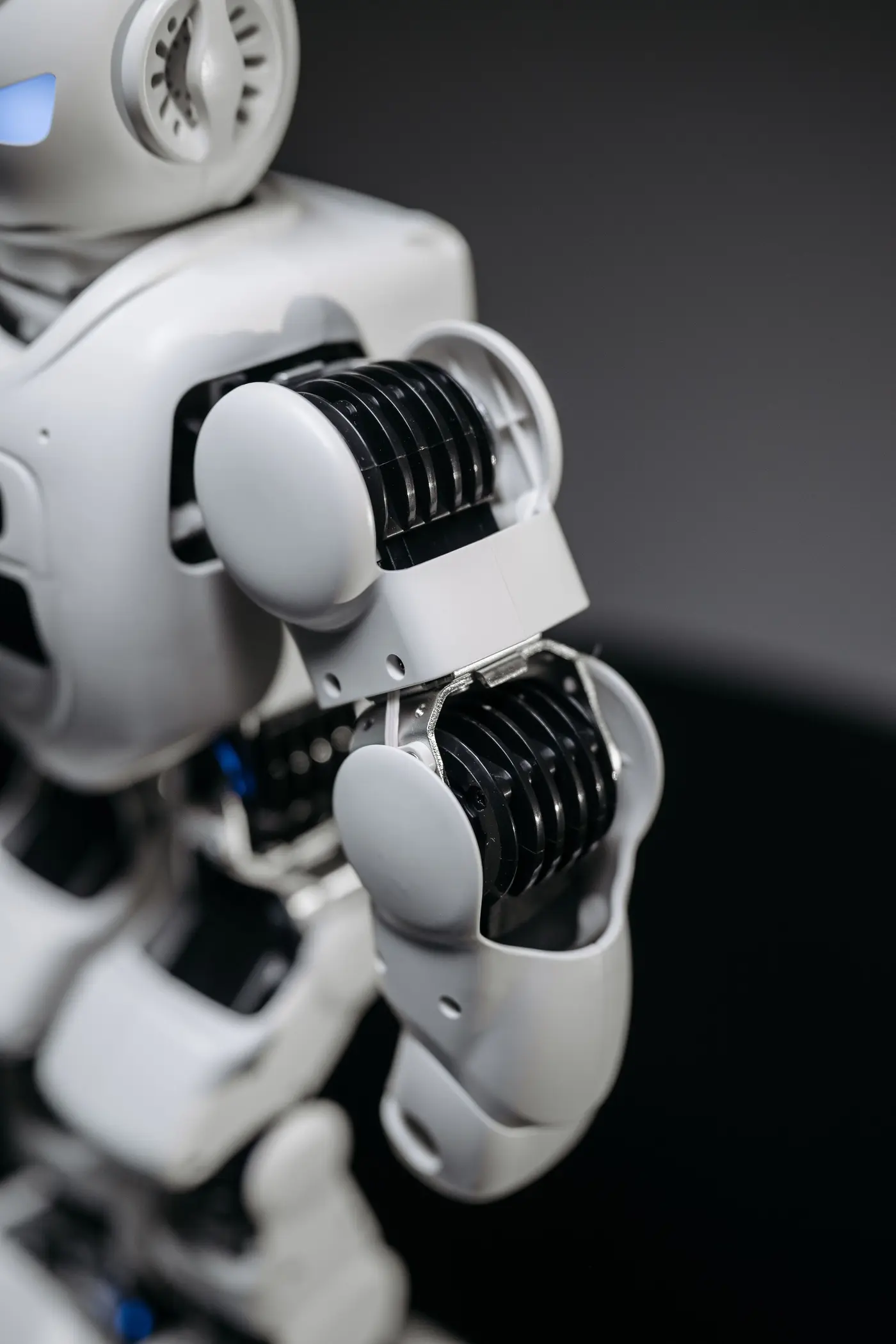
Our database holds 182 humanoid robots. 96 of them say anything about the hands. 13 give a degrees-of-freedom figure for the hand. 21 records use the word “dexterous”, and 20 of those never say how many joints that means. Makers describe the hand least and charge for it most, and both facts come from the same problem.
Why a hand is harder than a leg
A leg has a handful of joints, each with room for a large motor. A hand packs far more joints into a volume the size of a hand, and every joint needs its own actuator, position sensing and wiring. The motor that can hold a drill is too big for a finger. The motor that fits in a finger cannot hold the drill.
There are three ways out. Put small motors in the fingers or palm and accept a low joint count. Or move the motors into the forearm and pull the fingers with tendons: NEO from 1X is tendon driven, and so was the 11-DOF hand on Tesla’s Optimus Gen 1. Tesla’s announced Optimus V3 hand claims 22 DOF with forearm-mounted actuators; it is a prototype with no autonomy evidence in our record. Or use fluid: Phoenix from Sanctuary AI pairs an electric body with miniature hydraulic hands of about 20 DOF and tactile sensing. Its pilots used teleoperation.
The joint count shows how much of the machine the hands are. The Unitree G1 has 23 DOF as a body and up to 43 with hands fitted, so the hands add almost as many joints as the rest of the robot. Xpeng Iron lists 82 DOF in total with 22 per hand: more than half of its joints are in its hands. Every one is an actuator, a sensor and a thing that can break.
Hand DOF has barely moved since 2011
Where a hand DOF figure is published, it runs from 5 (the hobbyist InMoov, 3D printed with tendons) to 22 (Xpeng Iron and the announced Optimus V3), with a median of 12 across the 13 records. Figure 02 and Figure 03 sit at 16. Optimus Gen 2 has 11. Kepler K1 and Fourier GR-2 have 12.
Honda’s ASIMO had 13-DOF multi-fingered hands in its 2011 version, above today’s median. NASA’s Robonaut 2 launched to the ISS on 24 February 2011 with 12 DOF per hand, operated by crew and ground controllers. The joint count has not moved much in fifteen years. The software people hope to run on it has.
Only one machine you can order has a hand DOF figure in our data: the G1’s optional Dex3-1 three-finger hand, at 7 DOF.
The robots that have worked mostly have grippers
We sorted the hands text on all 96 records.
| Hand type as described | Machines | Examples |
|---|---|---|
| Five-finger or multi-finger, fitted as standard | 43 | Figure 03, Optimus Gen 2, NEO, Walker S2 |
| Optional, or gripper-or-hand variants | 18 | Unitree G1, H1, H2 and R1, Fourier GR-1, AgiBot A2 |
| No hands | 13 | MIT Humanoid, Berkeley Humanoid, Robotis OP3 |
| Gripper or two-finger | 11 | Digit, HRP-5P, Weave Isaac 1, RB-Y1 |
| Simple or unspecified hands | 9 | Honda P2, HRP-4, Sophia |
| Three-finger | 2 | DRC-HUBO, HRP-3 |
| Nothing said about the hands | 86 |
The gripper row holds the most convincing work. Digit from Agility Robotics uses two-finger end effectors built for totes and has moved them for GXO at a Spanx facility since 2024, autonomously with remote monitoring, which our record marks as partial teleoperation. AIST’s HRP-5P has two-finger hands and screwed a gypsum board to a wall by itself in a 2018 video, with no teleoperation. Weave Isaac 1 folds laundry with grippers for $7,999, and Weave says remote operators step in when it cannot finish.
In the five-finger row of 43, 8 say teleoperation yes, 19 partial, 12 unknown and 4 no. The 4 are Figure 02, Figure 03, Sony’s QRIO and WABOT-2. The most human-looking hands are, so far, the ones most often moved by a human somewhere else.
Hands are the line item
In our price data, hands turn the cheap configuration into the expensive one. The Unitree G1 is $13,500 as standard and $43,900 as the EDU with dexterous hands, Jetson Orin compute and the open SDK; Unitree does not price the hands on their own. The Unitree R1 AIR is $4,900; the R1 standard, which “adds manipulation”, is $5,900. The Booster T1 from Booster Robotics is $29,800 basic and $50,925 as the “Standard with grippers” through distributors: $21,125 more for grippers, not fingers.
Of the 44 humanoids you can order, 4 ship five-finger hands as standard: Dobot Atom at $27,500 on preorder, NEO at $20,000 with its Expert Mode teleoperation, and Leju Kuavo and Qinglong with no public price. 11 list hands as an option or a variant. 26 say nothing about the hands in their record.
What to check before you pay for “dexterous”
Ask for the DOF per hand and how many of those joints have their own motor; 20 of the 21 records that say “dexterous” do not give the number. Ask where the motors are, in the fingers, in the forearm on tendons, or hydraulic, because that decides weight and what breaks first. Ask about touch: 9 of 96 hands descriptions mention tactile sensing, and Figure 03 is the only one that puts a figure on it, fingertips sensitive to about 3 grams plus palm cameras. Ask whether the hand is in the quoted price or in the next configuration up. And ask what the hand has done with nobody on a controller. If your task is totes or boards, the machines that have actually done it had two fingers.
Unitree G1
G1 is Unitree's compact humanoid, announced in May 2024 at USD 16,000 and now listed at USD 13,500. Its low price and open SDK made it the default research and education humanoid worldwide. Read the configuration carefully: the standard machine does not support your own code, and the EDU version that does starts at USD 43,900.
Unitree R1
R1 is Unitree's low-cost humanoid, launched in July 2025 at CNY 39,900. At roughly a third of the G1 price it pushed the entry price for a walking humanoid below USD 6,000.
Unitree H1
H1 is Unitree's first full-size humanoid, revealed in August 2023. It set a walking speed of 3.3 m/s and performed the first standing backflip by a full-size electric humanoid in March 2024. Sixteen H1 units danced on the CCTV Spring Festival Gala in January 2025.
Booster T1
Booster T1 is a 1.18 m robust humanoid built for research and robot soccer. Its ability to survive falls made it popular with university RoboCup teams.
Figure 02
Figure 02, unveiled on 6 August 2024, added onboard speech, six cameras, 16 DoF hands and three times the compute of Figure 01. It became the first Figure robot to work in a customer plant, at BMW Spartanburg, and the platform for the Helix vision-language-action model. Figure retired it in favour of Figure 03 in late 2025.
Figure 03
Figure 03 is Figure AI's third-generation humanoid, unveiled on 9 October 2025 and designed for the home and for volume manufacturing at Figure's BotQ facility. It has soft textile coverings, wireless charging, palm cameras and tactile fingertips, and runs the Helix model onboard. It is the company's first robot designed for mass production rather than hand assembly.
Optimus Gen 1
Optimus Gen 1 was the first Tesla-designed humanoid, unveiled at AI Day 2022 with 28 actuators, an 11 DoF hand and a 2.3 kWh battery. It first walked untethered in videos in March and May 2023. Tesla positioned it as a product to be built at scale using its car-manufacturing know-how.
Optimus Gen 2
Optimus Gen 2, revealed on 12 December 2023, is about 10 kg lighter than Gen 1, walks 30 percent faster and has Tesla-designed actuators, an actuated neck and tactile fingers. It has been used for internal factory trials and at Tesla marketing events, where it was partly teleoperated. It is the version the public has seen most.
Optimus V3
Optimus V3 is the version Tesla describes as production-intent, with a new 22 DoF hand and forearm and a factory line in Fremont planned for 2026. Musk has repeatedly said V3 would be unveiled in early 2026 and that volume production is targeted for later in the decade. Tesla has stated a long-term ambition of one million units per year.
NEO
NEO is 1X's consumer home humanoid, opened for preorder on 28 October 2025 at USD 20,000 with deliveries planned for 2026. It is about 30 kg, tendon-driven and wears a soft suit, and it uses remote human operators for tasks it cannot yet do autonomously. It is the first humanoid marketed directly to households at a published price.
InMoov
InMoov is a life size, 3D printable open source humanoid started in 2012 by French sculptor Gael Langevin. Its upper body, hands and head can be printed on a desktop printer and driven by hobby servos and Arduino boards. It is the most widely built open source humanoid and a common school and maker project.
Phoenix
Phoenix is Sanctuary AI's general-purpose humanoid, first shown as Gen 6 in May 2023 and iterated to Gen 7 in April 2024 and Gen 8 in 2025. Its distinguishing feature is fast, miniaturised hydraulic hands with tactile sensing. Sanctuary has a manufacturing and deployment partnership with Magna.
Xpeng Iron
Iron is Xpeng's full-size humanoid, first shown in November 2024 working in its Guangzhou car plant. The 2025 version adds 82 degrees of freedom, a bionic spine, solid-state battery and Xpeng's own Turing chips, with mass production planned for late 2026.
Fourier GR-2
GR-2 doubled the battery capacity of GR-1 with a swappable pack and added 12-DOF hands, for a total of 53 degrees of freedom. The payload figure refers to each arm.
Kepler Forerunner K1
Forerunner K1 was Shanghai startup Kepler's first humanoid, shown at CES 2024 with a stated USD 30,000 target price and roller-screw linear actuators similar in concept to Tesla Optimus.
ASIMO
ASIMO, unveiled by Honda on 31 October 2000, was the best known humanoid of its era, evolving through several versions until the 2011 model that ran at 9 km/h. Honda ended development in 2018 and retired the robot from public shows in 2022.
Robonaut 2
Robonaut 2 was developed by NASA and General Motors and became the first humanoid robot in space when it launched to the ISS in February 2011. A leg set arrived in 2014 but hardware faults limited its use and it returned to Earth in 2018. Its dexterous hands influenced later industrial humanoids.
Digit
The 2023 Digit added a head, improved hands and a taller frame, and is the version Agility Robotics sells as a service for moving totes in warehouses. It was the first humanoid with a paid, multi-year commercial deployment (GXO, 2024) and is built at Agility's RoboFab factory. Schaeffler invested in Agility in 2024 and planned to deploy Digit in its plants.
HRP-5P
HRP-5P is AIST's construction-oriented humanoid that demonstrated autonomous drywall installation in 2018, aimed at labour shortages in Japanese building sites.
Weave Isaac 1
Isaac 1 is a wheeled home robot with two arms that collects and folds laundry, makes beds and resets rooms. At $7,999 it is the cheapest home robot with a stated delivery date, and the wheeled base is the reason: no legs means far less cost and far less that can go wrong.
Dobot Atom
Atom is the first humanoid from Dobot, a Shenzhen collaborative-robot maker listed in Hong Kong. It launched at CNY 199,000 with claims of 0.05 mm arm precision.
Leju Kuavo
Kuavo is the humanoid line of Leju Robotics, a Shenzhen company in the Huawei ecosystem. Kuavo 4.0 was released with open-source components in December 2024.
Qinglong (OpenLoong)
Qinglong is the 185 cm open-source humanoid of the Shanghai national humanoid robot innovation center, released as the OpenLoong platform at WAIC 2024.
Sony QRIO
QRIO was Sony's 58 cm entertainment humanoid that became the first bipedal robot to run in 2003. Sony cancelled it in 2006 during restructuring.
WABOT-2
WABOT-2 was Waseda's specialist musician robot, able to read a score and play a keyboard, presented at the 1985 Tsukuba science expo.
Sources
- 01
- 02Introducing Figure 03Figure AI
- 03
- 04Sanctuary AISanctuary AI
- 05NEO1X
- 06Agility RoboticsAgility Robotics
- 07
- 08Booster T1 humanoid robotGeneration Robots
- 09InMoovInMoov
How a humanoid robot works: actuators, compute, sensors and the model
Of 182 humanoids on record, 178 say what moves the joints and 43 say what computer is inside. The further a layer sits from the metal, the less the maker tells you about it.
Startups, automakers, universities: who builds humanoids
108 makers, nine kinds. Startups hold 37 of the 44 humanoids you can order. Automakers, universities, big tech, conglomerates and NASA hold 45 robots between them and sell none of them.
How long does a humanoid robot actually run
22 of 182 humanoids on record quote a runtime. The claims run from 1 to 8 hours with a median of 4, and of the 44 machines you can order, 4 say anything at all.