ASIMO
ASIMO, unveiled by Honda on 31 October 2000, was the best known humanoid of its era, evolving through several versions until the 2011 model that ran at 9 km/h. Honda ended development in 2018 and retired the robot from public shows in 2022.
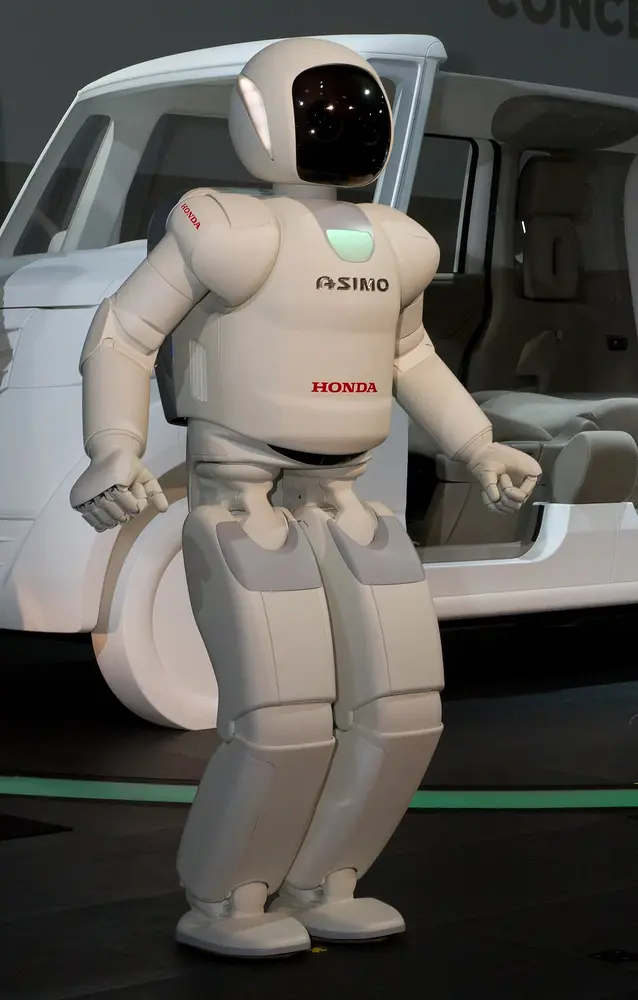 Morio via Wikimedia Commons · CC BY-SA 3.0
_2011_Tokyo_Motor_Show.jpg)
We have not sat down with this one. The score below is computed from the data we hold, and the facts on this page are sourced. It is not on sale, so there is nothing to recommend.
How the score is built
Capability is what the machine physically does. Value compares it with others at a similar price, not with the whole market. Buyability asks whether you can really order one. Ecosystem is the software and community around it. Proof is what it has done in the field, which is where most humanoids score badly and should.
- Status
- Retired
- Category
- historic
- First revealed
- 31 October 2000
- Form
- bipedal
- Height
- 130 cm
- Weight
- 48 kg
- Payload
- 1 kg
- Degrees of freedom
- 57 (+13 per hand)
- Battery
- n/a
- Runtime
- 1 h
- Walking speed
- 2.5 m/s
- Actuation
- electric servomotors
- Units deployed (est.)
- not disclosed
- Teleoperation
- partial
Where it stands
Development ended in 2018; final public demonstrations at Miraikan ended 31 March 2022. The ASIMO name lives on in Honda's ASIMO OS vehicle software.
What stands out
- Unveiled 31 October 2000
- 2011 version ran at 9 km/h with 57 DOF
- Retired 2022
Autonomy, observed
Ran at 9 km/h (2011 version), climbed stairs, poured drinks and navigated around people; thousands of public shows worldwide.
Demonstrations were largely pre-programmed with some autonomous navigation.
Hands, sensors, brain
- Hands: multi-fingered hands (2011 version) with tactile and force sensors
- Sensors: stereo cameras, ultrasonic and ground sensors, force sensors
- Compute: on-board
- AI stack: predictive movement control, face and voice recognition
Price and volume
Never sold; rental to companies reported at about USD 150,000 per year in the 2000s.
Where ASIMO works.
| Customer | Site | Sector | Task | Since | Status | Units | Autonomy |
|---|---|---|---|---|---|---|---|
| Honda (internal) | Honda headquarters, Aoyama, Tokyo, and Miraikan science museum, Japan | entertainment | Reception and guide duties at Honda's headquarters and daily shows at Miraikan | 2002 | ended | n/d | autonomous |
Milestones.
Honda stops developing ASIMO
Nikkei reports that Honda has disbanded the ASIMO development team and will focus on practical robotics such as mobility aids. ASIMO's public shows at Miraikan in Tokyo end in March 2022.
Honda presents an all new ASIMO with autonomous behaviour
The 2011 ASIMO runs at 9 km/h, hops on one leg, pours drinks and chooses its own path among people. Honda also derives a remote operated robot arm for the Fukushima Daiichi plant from the technology.
New ASIMO runs at 6 km/h
Honda's updated ASIMO runs at 6 km/h, pushes a cart, carries a tray and can act as a receptionist. The version is deployed at Honda's Tokyo headquarters as a guide.
Honda unveils ASIMO
Honda introduces ASIMO, a 120 cm, 43 kg humanoid that walks smoothly, changes direction while walking and recognises gestures. ASIMO becomes the most famous humanoid of the 2000s and is shown at Honda events and museums worldwide for two decades.
How long does a humanoid robot actually run
22 of 182 humanoids on record quote a runtime. The claims run from 1 to 8 hours with a median of 4, and of the 44 machines you can order, 4 say anything at all.
Japan built the first humanoids, then stopped shipping them
Japan has 24 humanoids and 12 makers in our record, more than any country except China and the United States. Two of the 24 can be ordered today, and both were first shown in 2009.
Startups, automakers, universities: who builds humanoids
108 makers, nine kinds. Startups hold 37 of the 44 humanoids you can order. Automakers, universities, big tech, conglomerates and NASA hold 45 robots between them and sell none of them.
44 you can order, 138 you cannot: the gap explained
We keep a record of 182 humanoid robots. Fewer than a quarter of them will sell you one, and of those, only eight tell you the price on their own website. Here is where the rest went.
A short history of the humanoid, from Elektro to the order button
Our record holds 111 dated milestones since 1939. Sixty-eight of them are from this decade, and what changed was not the walking. It was the price tag.
Humanoid robot stocks: which of the 108 makers are actually listed
Twenty of the 108 makers in our record have a ticker. Four of them will sell you a humanoid. The rest build cars, chips, servers and washing machines, and the pure plays are all private.
Other robots by Honda.
Honda E series (E0 to E6)
Honda's E series were seven legged research machines developed in secret between 1986 and 1993, progressing from static to dynamic walking and stair climbing. They were revealed publicly only when P2 was announced in 1996.
Honda P2
P2 was the first humanoid to carry its own power and computing while walking, an achievement that surprised the robotics community when Honda revealed it in December 1996.
Honda P3
P3 reduced P2's size and weight to 160 cm and 130 kg and became the basis of the Japanese government's HRP-1 platform.
Sources
- 01ASIMO, Honda globalHonda
- 02ASIMO, WikipediaWikipedia
Spotted a wrong price or a broken fact? Send a correction. Fixed within 24 hours when sourced.