Unitree G1
G1 is Unitree's compact humanoid, announced in May 2024 at USD 16,000 and now listed at USD 13,500. Its low price and open SDK made it the default research and education humanoid worldwide. Read the configuration carefully: the standard machine does not support your own code, and the EDU version that does starts at USD 43,900.
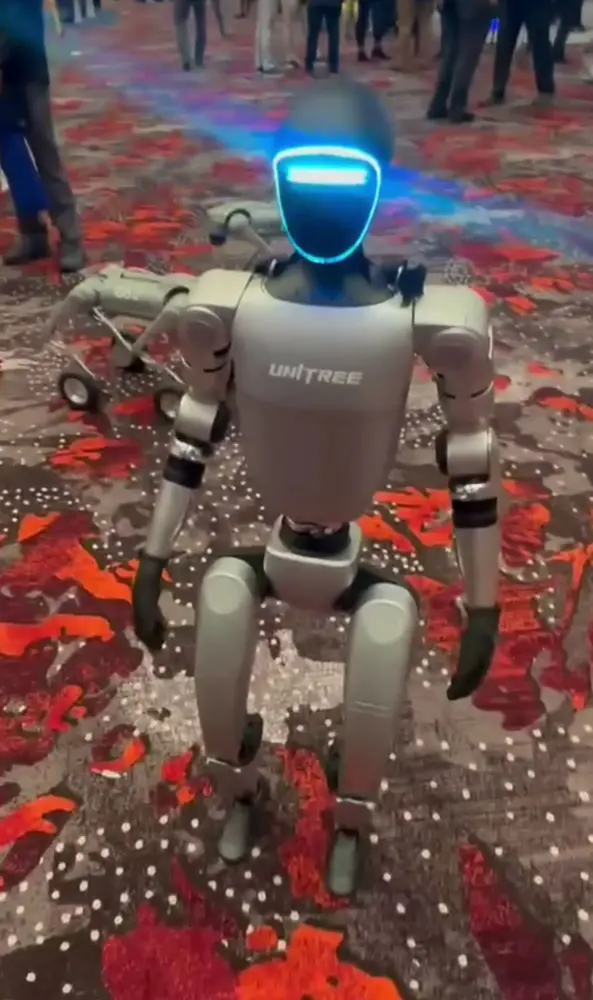 Sayanesy via Wikimedia Commons · CC0
The verdict
The default humanoid of the moment, and the only full-featured machine that a well-funded individual can order without a procurement department. It walks, runs, gets up off the floor and has more third-party code written for it than anything else on this list. The catch is the configuration ladder: the $13,500 machine cannot run your own code, and the version that can starts at $43,900.
- Buy it if
- Labs, universities and serious builders who want the platform everybody else is already using.
- Skip it if
- You expected the advertised price to buy a programmable robot. It does not.
In its favour
- Enormous community and open SDK
- Learned locomotion that genuinely works
- Folds to 69 cm for transport
Against it
- Standard version is closed to your own code
- Backordered more often than not
- Two hours of battery in practice
How the score is built
Capability is what the machine physically does. Value compares it with others at a similar price, not with the whole market. Buyability asks whether you can really order one. Ecosystem is the software and community around it. Proof is what it has done in the field, which is where most humanoids score badly and should.
Similar money, different machine.
- Status
- Commercial
- Category
- research
- First revealed
- 13 May 2024
- Form
- bipedal
- Height
- 132 cm
- Weight
- 35 kg
- Payload
- n/a
- Degrees of freedom
- 23 (+7 per hand)
- Battery
- 0.75 kWh
- Runtime
- 2 h
- Walking speed
- 2 m/s
- Actuation
- electric (knee joint torque up to 120 Nm)
- Units deployed (est.)
- not disclosed
- Teleoperation
- partial
Where it stands
In volume production and shipping worldwide since mid 2024; the most widely used humanoid research platform by unit count.
What stands out
- Listed at USD 13,500, down from USD 16,000 at launch
- EDU version with hands and Jetson compute from USD 43,900
- Folds to 69 cm for transport
Autonomy, observed
Learned locomotion (walking, running, kung fu, dancing, standing up from the floor) demonstrated in many independent lab videos; boxing matches at the 2025 World Humanoid Robot Games in Beijing.
VR teleoperation supported via open-source projects (for example Unitree avp_teleoperate).
Hands, sensors, brain
- Hands: optional Dex3-1 three-finger hand (7 DOF) or five-finger hands on EDU versions; up to 43 DOF total
- Sensors: Intel RealSense D435i depth camera, Livox Mid-360 3D LiDAR, microphone array
- Compute: 8-core CPU on base model; Nvidia Jetson Orin NX (100 TOPS) on EDU versions
- AI stack: reinforcement-learning locomotion; open SDK (unitree_sdk2, unitree_rl_gym); widely used with third-party VLA models
Price and volume
Base G1 listed at USD 16,000 (CNY 99,000); EDU versions with hands and Jetson compute cost several times more.
Unitree has not published a unit count; multiple reports in 2025 described G1 as the highest-volume humanoid in the world.
Index position
In the Humanoid Index, which ranks on shipped reality rather than value for money, Unitree G1 sits at #2 of 107 with 58 points: deployment 20/50, autonomy 18/30, availability 20/20. See that method.
Where Unitree G1 works.
| Customer | Site | Sector | Task | Since | Status | Units | Autonomy |
|---|---|---|---|---|---|---|---|
| China Mobile | China Mobile subsidiaries (deployment sites not disclosed), China | other | Small humanoid robots procured for showrooms and service tasks | Jun 2025 | announced | n/d | unknown |
| Universities and AI labs (various) | Worldwide, China | research | Locomotion and manipulation research, teleoperation data collection and education | Aug 2024 | active | n/d | mixed |
Milestones.
Unitree files for a listing on Shanghai's STAR Market
Unitree, after completing pre listing tutoring with CITIC Securities, files for an initial public offering on the Shanghai Stock Exchange STAR Market. It is the first pure play humanoid maker to seek a public listing in China.
First World Humanoid Robot Games open in Beijing
Around 280 teams from 16 countries compete in the National Speed Skating Oval in athletics, football, dance and applied tasks such as medicine sorting and hotel cleaning. Unitree robots win most track events, including the 1500 m in 6 minutes 34 seconds, while frequent falls show the state of the art.
First humanoid robot boxing tournament in Hangzhou
Four teleoperated Unitree G1 robots box in the CMG World Robot Competition Mecha Fighting Series, broadcast by state television. The event starts a series of combat competitions used as marketing for Chinese humanoids.
Unitree unveils G1 at 16,000 dollars
Unitree announces G1, a 127 cm, 35 kg humanoid with 23 to 43 degrees of freedom starting at 16,000 dollars. The price, an order of magnitude below competitors, makes G1 the most widely purchased research humanoid within a year.
Deposits, lead times and warranties: reading a humanoid order sheet
Of 42 buy records, 2 publish a deposit, 1 a warranty, 1 a shipping cost and none a lead time in weeks. The order sheet for a humanoid is mostly blank, and the blanks are where the money goes.
How a humanoid robot works: actuators, compute, sensors and the model
Of 182 humanoids on record, 178 say what moves the joints and 43 say what computer is inside. The further a layer sits from the metal, the less the maker tells you about it.
How long does a humanoid robot actually run
22 of 182 humanoids on record quote a runtime. The claims run from 1 to 8 hours with a median of 4, and of the 44 machines you can order, 4 say anything at all.
Humanoid races, games and fights: what the competitions proved
Our record holds 11 competition events from 1997 to 2025 and 17 machines tied to them. Six can be ordered, three at a public price, and 13 of the 17 carry a teleoperation flag of yes or partial.
Japan built the first humanoids, then stopped shipping them
Japan has 24 humanoids and 12 makers in our record, more than any country except China and the United States. Two of the 24 can be ordered today, and both were first shown in 2009.
Open-source humanoids: what you can actually build
24 of the 182 humanoids on record call themselves open source. 15 publish hardware files and software, 3 name a licence, 12 can be ordered, and none of the four on preorder has any autonomy evidence yet.
Other robots by Unitree Robotics.
Unitree H1
H1 is Unitree's first full-size humanoid, revealed in August 2023. It set a walking speed of 3.3 m/s and performed the first standing backflip by a full-size electric humanoid in March 2024. Sixteen H1 units danced on the CCTV Spring Festival Gala in January 2025.
Unitree H1-2
H1-2 is the second iteration of the full-size H1 line with 27 degrees of freedom (six per leg, seven per arm, one waist joint) and support for dexterous hands. It is mainly a research platform.
Unitree H2
H2 is Unitree's third full-size humanoid, revealed in October 2025 with 31 degrees of freedom, 180 cm height and 70 kg weight. It is positioned as a general-purpose and entertainment platform.
Unitree R1
R1 is Unitree's low-cost humanoid, launched in July 2025 at CNY 39,900. At roughly a third of the G1 price it pushed the entry price for a walking humanoid below USD 6,000.
Sources
- 01Unitree G1 product pageUnitree
Price sources
- 01Unitree G1 product pageUnitree · 2026-09-04
- 02Humanoid robots for sale: 2026 guideThere's A Robot For That · 2026-08-15
Spotted a wrong price or a broken fact? Send a correction. Fixed within 24 hours when sourced.