Humanoid races, games and fights: what the competitions proved
Our record holds 11 competition events from 1997 to 2025 and 17 machines tied to them. Six can be ordered, three at a public price, and 13 of the 17 carry a teleoperation flag of yes or partial.
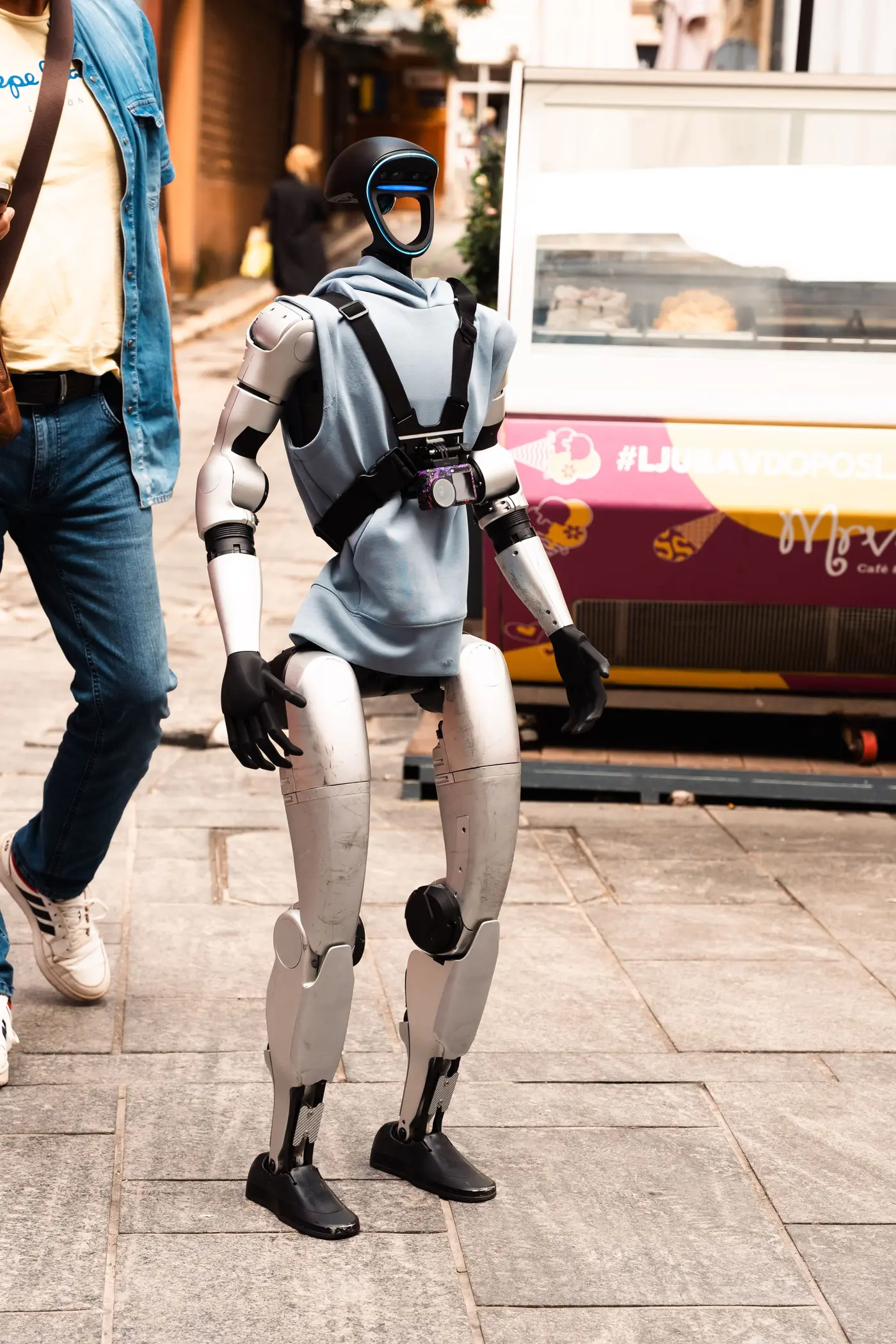
Humanoid competitions have produced three kinds of result: a supervised machine finishing a fixed course, an autonomous machine kicking a ball, and a remote-controlled machine hitting another one. Our events file holds 11 competition records from 1997 to 2025, and 17 robots in the database are tied to one of them. Six can be ordered. The winners of the two biggest prizes are not for sale, and 13 of the 17 are flagged as teleoperated in full or in part.
The DARPA Robotics Challenge tested work, with a human on the radio
The one competition built around work was the DARPA Robotics Challenge, announced on 10 April 2012 after Fukushima, with a $2 million prize for robots that could work in disaster environments built for people. DARPA funded the hydraulic Atlas as a platform for software teams; Boston Dynamics supplied seven copies in 2013.
At the trials in Homestead on 20 December 2013, sixteen teams faced eight disaster-response tasks. SCHAFT S-One from SCHAFT scored 27 of 32 points and won, ahead of IHMC on an Atlas. At the finals in Pomona on 6 June 2015, KAIST’s DRC-HUBO+ completed all eight tasks in 44 minutes 28 seconds and took the $2 million.
The DRC-HUBO+ record says “supervised teleoperation under DRC rules”. The SCHAFT record says “operated with human supervision as allowed by the DRC rules”. THORMANG3 from Robotis is flagged teleoperation yes, “used with operator interfaces”. DRC entrants Valkyrie from NASA and WALK-MAN from IIT are flagged yes too. The hydraulic Atlas is the only DRC machine flagged no, and that flag describes its backflip and parkour videos, not its DRC runs under the same supervised rules.
What the DRC proved: with an operator watching, a humanoid could finish a known set of tasks on a known course in under an hour. What it did not produce: a product. Of the six DRC machines in our data, none is for sale and none has a deployment record.
RoboCup is the one competition where autonomy is the rule
RoboCup started in Nagoya in August 1997 with about 40 teams and a stated goal of beating the human World Cup champions by 2050. The Humanoid League followed in Fukuoka in June 2002 with walking, penalty kicks and free style events. In August 2007 RoboCup chose the 58 cm NAO from Aldebaran as the Standard Platform League robot, and NAO became the most widely sold humanoid on record, over 13,000 units.
RoboCup machines are the ones in our data that say autonomous and mean it. NimbRo-OP2X from the University of Bonn won adult-size titles playing fully autonomous soccer and is flagged teleoperation no. ROBOTIS OP3 and its predecessor DARwIn-OP play autonomous kid-size soccer, both flagged no. Booster T1 from Booster Robotics became the kid-size standard platform in 2025 and its record says “autonomous soccer at RoboCup 2025”, although the machine as sold is flagged partial.
The same Bonn team won the ANA Avatar XPRIZE on 5 November 2022, a $5 million prize for a telepresence avatar. That competition was teleoperation by design: the people who win the autonomous league also won the prize for putting a human in the loop well.
What RoboCup proves: on-board perception and decision-making work at small scale, on a flat field, with a ball. NAO is 5.5 kg. It says nothing about lifting a tote.
The 2025 season: a half marathon, a boxing ring and a stadium
Three of the 11 competition records fall in 2025, all in China.
On 19 April 2025, 21 humanoid teams ran 21.1 km alongside human runners in Beijing’s Yizhuang district. Tiangong Ultra from X-Humanoid finished first in 2 hours 40 minutes 42 seconds, an average of 2.19 m/s or 7.9 km/h. Its record notes a human pacer alongside and batteries swapped during the race; the event record says most teams had handlers. Six of 21 robots completed the course. Several fell or overheated. Noetix N2 from Noetix came second and Leju Kuavo from Leju finished.
On 25 May 2025 in Hangzhou, four Unitree G1 robots boxed in the CMG World Robot Competition Mecha Fighting Series on state television. The event record is explicit: four teleoperated G1s, and it calls the series marketing for Chinese humanoids. The G1’s own record lists boxing among its autonomy evidence. Both lines stay because that is what the sources say; read the first.
From 14 August 2025, around 280 teams from 16 countries competed at the first World Humanoid Robot Games in Beijing: athletics, football, dance and applied tasks such as medicine sorting and hotel cleaning. Unitree robots won most track events, including a 1500 m in 6 minutes 34 seconds, an average of 3.81 m/s. The record does not say which model ran it; the H1 claims 3.3 m/s as a walking record. Tiangong Ultra took track wins too. The event record states no control mode and notes frequent falls. For the applied tasks, the ones that resemble work, our record has no winner and no control mode.
| Date | Event | Task | Winner, per record | Control mode |
|---|---|---|---|---|
| August 1997 | First RoboCup, Nagoya | Robot soccer, about 40 teams | Not recorded | Autonomous play |
| June 2002 | RoboCup Humanoid League, Fukuoka | Walking, penalty kicks, free style | Not recorded | Autonomous play |
| August 2007 | RoboCup Standard Platform League | Platform choice, not a contest | NAO selected | Autonomous play |
| 10 April 2012 | DRC announced | Eight disaster tasks, $2 million | Not applicable | Supervised teleoperation allowed |
| 20 December 2013 | DRC Trials, Homestead | Eight tasks, 16 teams | SCHAFT S-One, 27 of 32 points | Supervised teleoperation |
| June 2015 | DRC Finals, Team ROBOTIS entry | THORMANG3 platform | Not applicable | Operator interfaces |
| 6 June 2015 | DRC Finals, Pomona | Eight tasks in one run | DRC-HUBO+, 44 min 28 s | Supervised teleoperation |
| 5 November 2022 | ANA Avatar XPRIZE, Long Beach | Telepresence avatar, $5 million | NimbRo, University of Bonn | Teleoperation by design |
| 19 April 2025 | Beijing half marathon | 21.1 km, 21 teams, 6 finished | Tiangong Ultra, 2:40:42 | Handlers, pacer, battery swaps |
| 25 May 2025 | Hangzhou boxing, Mecha Fighting Series | Boxing, four G1 | Not recorded | Teleoperated |
| 14 August 2025 | World Humanoid Robot Games, Beijing | Athletics, football, dance, applied tasks | Unitree, most track events | Not stated; H1 and G1 flagged partial |
A race is a controlled course with a known surface and a support crew. A fight, where the record says so, is a remote-control event. Neither is a workplace.
The gala and the Tianjin lunge are the same machine
Two more records belong here, though neither is a competition. On 28 January 2025, sixteen Unitree H1 robots danced a folk routine with human dancers on the CCTV Spring Festival Gala. Our deployment record files it under entertainment, customer China Media Group, 16 units, autonomy “autonomous”, ended the same day. For a rehearsed dance, autonomous means a fixed routine run without a controller; the H1 record says its manipulation demos are “mostly scripted or teleoperated” and flags the machine partial. It is the only H1 deployment on file.
Twelve days later, on 9 February 2025, an H1 performing at a lantern festival in Tianjin stumbled and jerked toward the crowd barrier before handlers pulled it back. Organisers said a program failure was the cause. Nobody was hurt. It is the only incident record in the file and the reference case for humanoids in crowds. The machine that made Unitree a household name and the machine that lunged were the same model, in the same fortnight.
Who competes, and what it costs
Of the 17 machines tied to a competition, 6 are orderable, 3 of those at a public price. Ten are flagged partial, 3 yes and 4 no. The four flagged no are three small RoboCup soccer robots and a retired hydraulic Atlas.
| Machine | Competition in record | Availability | Price | Teleoperation flag |
|---|---|---|---|---|
| Unitree G1 | Hangzhou boxing; Games | In stock, backordered | $13,500 to $73,900 | partial |
| Noetix N2 | Half marathon, second place | In stock | $5,500 | partial |
| Booster T1 | RoboCup 2025 platform | In stock via distributors | $29,800 | partial |
| Tiangong 1.0 | Half marathon, base platform | In stock | No public price | partial |
| Leju Kuavo | Half marathon finisher | In stock | No public price | partial |
| ROBOTIS OP3 | RoboCup kid size | In stock | No public price | no |
| Unitree H1 | Games; gala; Tianjin | Enterprise only | $90,000, by quote | partial |
| NAO | RoboCup SPL since 2008 | Enterprise only | By quote | partial |
| Tiangong Ultra | Half marathon winner; Games | Not for sale | None | partial |
| NimbRo-OP2X | RoboCup adult size titles | Not for sale | None | no |
| DARwIn-OP | RoboCup kid size | Discontinued | $12,000 at launch | no |
| DRC-HUBO+ | DRC Finals winner | Not for sale | None | partial |
| SCHAFT S-One | DRC Trials winner | Not for sale | None | partial |
| Atlas (hydraulic) | DRC 2013 to 2015 | Not for sale | None | no |
| THORMANG3 | DRC Finals | Discontinued | Not public | yes |
| Valkyrie | DRC Trials 2013 | Not for sale | None | yes |
| WALK-MAN | DRC Finals 2015 | Not for sale | None | yes |
The winners are not the products. Tiangong Ultra is a 180 cm, 52 kg competition version, not for sale; what you can buy is the 163 cm, 43 kg Tiangong 1.0, with no public price. The G1s in the ring were on controllers and the ones at the Games were fielded by teams; the $13,500 G1 standard in the Unitree store is closed to your code, and the open EDU version starts at $43,900 (see the G1 configuration ladder). The H1 that danced is a sales conversation at $90,000. The DRC machines are in labs and museums.
Deployments say the same. Among the 17, the G1 has two (research labs worldwide, and a China Mobile tender with no unit count), Leju Kuavo one unclear pilot at BAIC, NAO education and research, the H1 the gala. The other 13 have none. Nothing in the 52 deployments on record cites a competition as the reason anyone bought.
What a buyer should take from a result, and what to ignore
Take the finishing rate. Six of 21 in the half marathon is the honest number, and it tells you about heat and batteries on a two-hour task. The G1 record lists two hours of runtime; the marathon winner needed swaps. If your shift is eight hours, start there.
Take the falls. Every 2025 record mentions them, and a machine that gets up after a fall in a stadium has a balance controller that works. It is the one thing the fights show too.
Take the control mode as written. Supervised teleoperation at the DRC, handlers and a pacer at the marathon, remote control in the ring. Where the record is silent, as it is for the Games’ applied tasks, assume nothing.
Ignore a win by a model you cannot buy. Ignore a dance. Ignore a boxing match as evidence of anything except shove recovery and a broadcast contract. Ignore “wins most track events” until you know which configuration ran and whether it is the one on the order form.
Check that the competition task is your task. The only competition on record that tried real work, the DRC, was won with an operator on the line and ended with no product. The fully autonomous ones were played by 58 cm robots with a ball. Nothing in the 11 records shows a humanoid completing a work task, unsupervised, on a course it had not seen. If a seller shows you a medal, ask for the deployment instead.
Unitree G1
G1 is Unitree's compact humanoid, announced in May 2024 at USD 16,000 and now listed at USD 13,500. Its low price and open SDK made it the default research and education humanoid worldwide. Read the configuration carefully: the standard machine does not support your own code, and the EDU version that does starts at USD 43,900.
Unitree H1
H1 is Unitree's first full-size humanoid, revealed in August 2023. It set a walking speed of 3.3 m/s and performed the first standing backflip by a full-size electric humanoid in March 2024. Sixteen H1 units danced on the CCTV Spring Festival Gala in January 2025.
Tiangong 1.0
Tiangong was presented as the first full-size electric humanoid able to run, and released as an open platform by the Beijing Humanoid Robot Innovation Center in April 2024.
Tiangong Ultra
Tiangong Ultra is the athletic version of Tiangong that won the world's first humanoid half marathon in Beijing in April 2025, then took track medals at the August 2025 World Humanoid Robot Games.
Noetix N2
N2 is a 1.2 m humanoid from Beijing startup Noetix priced at CNY 39,900, which placed second at the first humanoid half marathon in April 2025.
Leju Kuavo
Kuavo is the humanoid line of Leju Robotics, a Shenzhen company in the Huawei ecosystem. Kuavo 4.0 was released with open-source components in December 2024.
Booster T1
Booster T1 is a 1.18 m robust humanoid built for research and robot soccer. Its ability to survive falls made it popular with university RoboCup teams.
NAO
NAO is a 58 cm programmable humanoid from Aldebaran, first sold in 2008 and adopted as the RoboCup standard platform. It is the most widely distributed humanoid in education and research with over 13,000 units. The current NAO6 dates from 2018.
NimbRo-OP2X
NimbRo-OP2X is an open source, largely 3D printed, adult size humanoid from the Autonomous Intelligent Systems group at the University of Bonn led by Sven Behnke. It is the third generation of the NimbRo-OP line that started in 2012 and has won multiple RoboCup Humanoid League adult size titles. Hardware designs and software are public.
ROBOTIS OP3
ROBOTIS OP3 is the third generation of the open platform humanoid line that started with DARwIn-OP. It is a 51 cm, 3.5 kg kid size research robot with 20 degrees of freedom, an Intel NUC and a ROS based open source software stack. It is used in RoboCup and in teaching labs worldwide.
DARwIn-OP
DARwIn-OP (Dynamic Anthropomorphic Robot with Intelligence, Open Platform) is a 45 cm open hardware and open software humanoid developed by Virginia Tech's RoMeLa lab with Purdue, Penn and Robotis under a US National Science Foundation grant. Released in late 2010, it became the standard kid size platform in RoboCup and in university teaching. Robotis productised it and followed with OP2 and OP3.
DRC-HUBO+
DRC-HUBO+ from Team KAIST won the 2015 DARPA Robotics Challenge Finals and the USD 2 million prize, using a transformable design that kneels onto wheels for stable driving.
SCHAFT S-One
S-One was the humanoid of University of Tokyo spin-out SCHAFT, acquired by Google in 2013, which won the DARPA Robotics Challenge Trials. A later bipedal prototype was shown in 2016 before Alphabet shut the company in 2018.
Atlas (hydraulic)
The hydraulic Atlas was unveiled in July 2013 for the DARPA Robotics Challenge and became the best-known research humanoid of the 2010s through its parkour and backflip videos. Later versions were 150 cm tall, 89 kg and had 28 hydraulic joints. Boston Dynamics retired it in April 2024.
THORMANG3
THORMANG3 is a modular full size humanoid built by Robotis from its Dynamixel Pro actuators and released in 2015 for research teams, including at the DARPA Robotics Challenge finals. It runs an open source ROS framework and was sold to universities worldwide. It represents the DRC era of modular research humanoids.
Valkyrie
Valkyrie (R5) is NASA Johnson Space Center's electric humanoid, built in 2013 for the DARPA Robotics Challenge and later loaned to universities and to Woodside Energy for remote-operation research. Several Apptronik founders worked on it. It remains a research platform.
WALK-MAN
WALK-MAN was a large humanoid built by IIT with the University of Pisa and partners under an EU project for disaster response, and it competed in the 2015 DARPA Robotics Challenge finals. The project produced a second, lighter version in 2017.
Sources
- 01DARPA Robotics ChallengeWikipedia
- 02World Humanoid Robot GamesWikipedia
- 03Beijing Humanoid Robot Innovation CenterX-Humanoid
- 04UnitreeUnitree
- 05
- 06RoboCup FederationRoboCup
- 07ANA Avatar XPRIZEXPRIZE
- 08Noetix RoboticsNoetix
Open-source humanoids: what you can actually build
24 of the 182 humanoids on record call themselves open source. 15 publish hardware files and software, 3 name a licence, 12 can be ordered, and none of the four on preorder has any autonomy evidence yet.
Startups, automakers, universities: who builds humanoids
108 makers, nine kinds. Startups hold 37 of the 44 humanoids you can order. Automakers, universities, big tech, conglomerates and NASA hold 45 robots between them and sell none of them.
How a humanoid robot works: actuators, compute, sensors and the model
Of 182 humanoids on record, 178 say what moves the joints and 43 say what computer is inside. The further a layer sits from the metal, the less the maker tells you about it.