Rollin' Justin
Rollin' Justin is DLR's wheeled humanoid with two lightweight torque-controlled arms and dexterous hands, developed from 2008 for manipulation research and later commanded from the International Space Station in supervised-autonomy experiments.
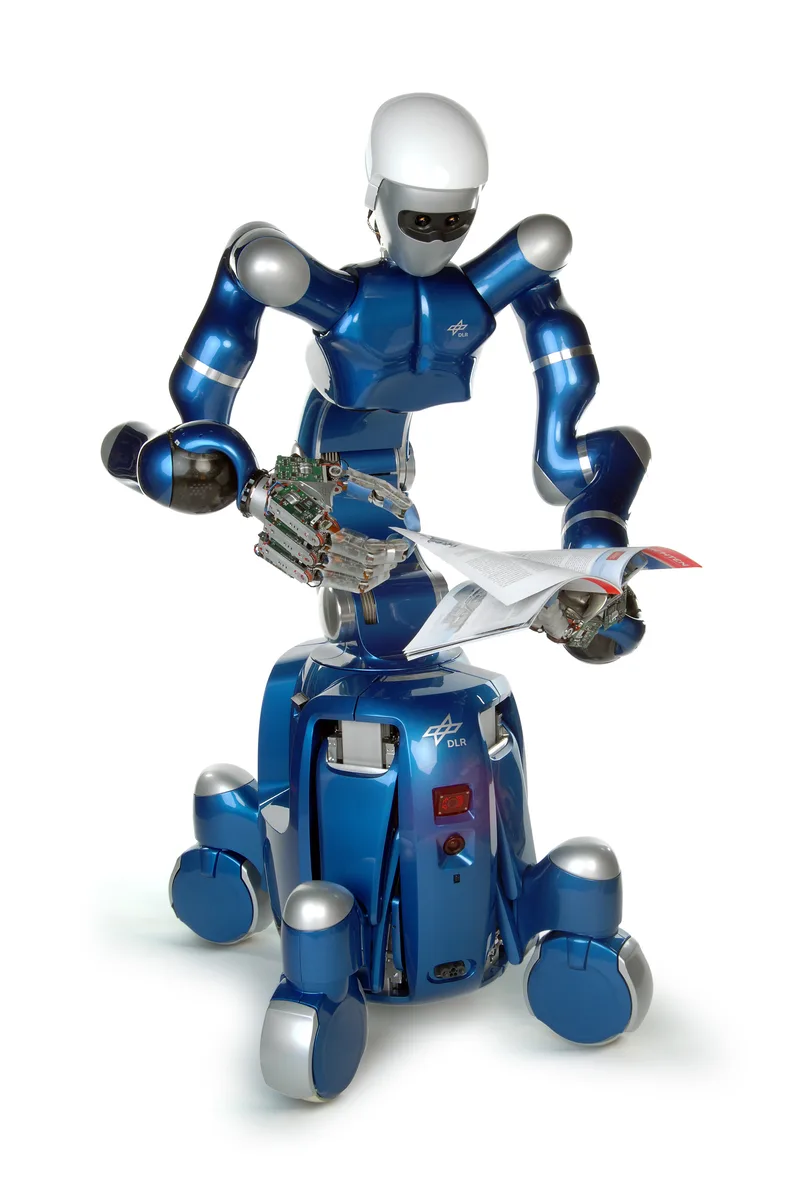 German Aerospace Center (DLR), Institute of Robotics and Mechatronics press image
We have not sat down with this one. The score below is computed from the data we hold, and the facts on this page are sourced. It is not on sale, so there is nothing to recommend.
How the score is built
Capability is what the machine physically does. Value compares it with others at a similar price, not with the whole market. Buyability asks whether you can really order one. Ecosystem is the software and community around it. Proof is what it has done in the field, which is where most humanoids score badly and should.
What people buy instead.
- Status
- Research
- Category
- research
- First revealed
- 2008
- Form
- wheeled-base
- Height
- n/a
- Weight
- n/a
- Payload
- n/a
- Degrees of freedom
- n/a
- Battery
- n/a
- Runtime
- n/a
- Walking speed
- n/a
- Actuation
- electric, torque-controlled lightweight arms
- Units deployed (est.)
- not disclosed
- Teleoperation
- yes
Where it stands
Wheeled upper-body humanoid at DLR since 2008; used for manipulation and space telerobotics research.
What stands out
- Two DLR lightweight arms with four-finger hands
- Commanded from the ISS (2017, 2018)
Autonomy, observed
Commanded from the ISS by astronauts in the METERON and SUPVIS Justin experiments (2017 to 2018).
Price and volume
research platform
Other robots by German Aerospace Center (DLR), Institute of Robotics and Mechatronics.
Sources
- 01
Spotted a wrong price or a broken fact? Send a correction. Fixed within 24 hours when sourced.